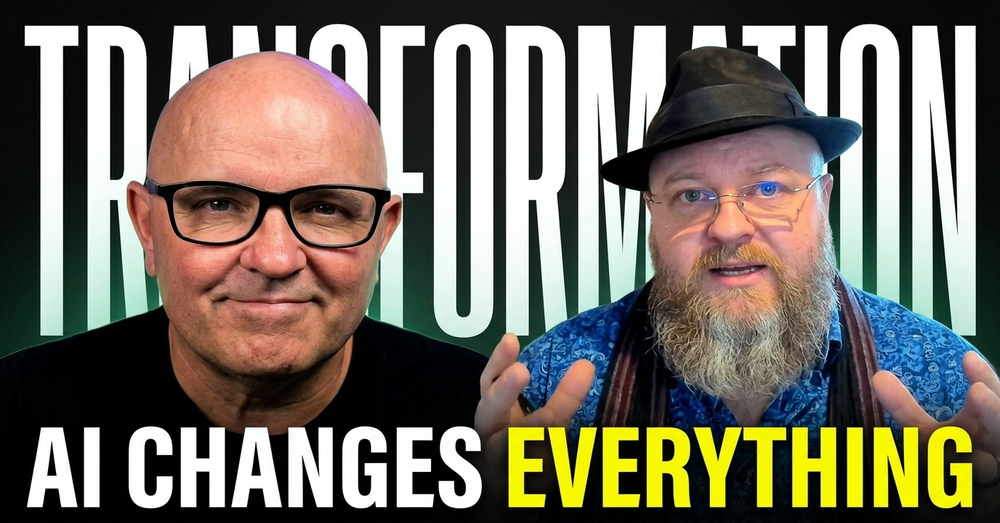
Why AI Is Becoming a Business Transformation, Not a Technology Upgrade
Sean G Muller

 Spotify
 Apple Podcasts
 YouTube
 RSS Feed
 Amazon Music
 PocketCasts
 iHeartRadio
 Podcast Addict
 Why AI Is Becoming a Business Transformation, Not a Technology Upgrade
Full Show Notes
https://www.theintelligenceagepodcast.com/838
AI is about to replace bloated SaaS, and most businesses are still only playing with chatbots
Sean G Muller says the next wave of AI is not about better prompts or prettier copilots. It is about rebuilding business around context, agents, and what actually creates value - before your software stack becomes the expensive middleman.
Mark Smth and Sean unpack why the last six months have been a genuine shift: agentic loops are now good enough to handle real business work, not just experiments. Sean explains how he moved from traditional technical architecture into building full application pipelines, MCP servers, and background agents that review email, track social signals, draft responses, and keep business moving without adding more human overhead.
You'll discover why context is the missing ingredient in almost every failed AI project, how Sean uses a simple meal-planning example to explain it, and why companies that scatter knowledge across laptops, SharePoint, Google Cloud, and people's heads are sitting on hidden risk. Sean also breaks down the difference between AI as a feature and AI as a business transformation engine, including the mistake many firms make when they bolt chat onto old workflows and call it progress.
We also get into the coming SaaS pocalypse - the idea that tools like HubSpot, Salesforce, Xero, Slack, and Atlassian may face a serious reckoning as businesses realize they can build leaner, custom, agent-first systems for less than the cost of endless licenses and modules. Sean shares how he built a headless, agent-driven CRM and why he thinks greenfield builds will replace expensive transformation projects much sooner than most executives expect. This conversation matters if you lead a business, run operations, own a small or mid-sized company, or simply suspect your current software is forcing you to work the wrong way. If you want to understand where AI is actually delivering leverage right now - and how to avoid wasting money on shallow pilots - this episode is essential listening.
Mark Smth hosts the conversation and brings the enterprise and product lens, pushing Sean to get specific about what success looks like for real businesses in New Zealand.
Sean G Muller is an AI and enterprise architecture specialist based in New Zealand, known for helping organizations build practical AI systems, implement agentic workflows, and rethink business process from the ground up.
Resources
1. The Cuckoo's Egg: Tracking a Spy Through the Maze of Computer Espionage - https://www.amazon.com.au/dp/0385249462?ref_=mr_referred_us_au_nz
2. Gemini: A Family of Highly Capable Multimodal Models — 2312.11805.pdf https://arxiv.org/abs/2312.11805
3. On the Measure of Intelligence — 1911.01547.pdf - https://arxiv.org/pdf/1911.01547
If you want to get in touch with me, you can message me here on Linkedin.
Thanks for listening 🚀 - Mark Smith
00:44 - Introduction to AI and Personal Life
03:27 - The Evolution of Healthcare with AI
06:07 - Shifts in AI Landscape and Business Applications
09:04 - Successful AI Implementations in Business
11:57 - Understanding Context in AI Projects
14:59 - Business Transformation vs. Technology Transformation
18:04 - The Future of SaaS and AI Innovations
22:22 - Transforming Business Processes with AI
27:22 - Understanding AI Implementation in SMEs
33:40 - The Future of Business Context and AI
Mark Smith
The intelligence age is not coming. We're already living in it. I'm Mark Smith, and each week I speak with the people building, leading, and navigating a world being reshaped by artificial intelligence. We explore AI technology, the changing nature of work, and what it takes to build a meaningful career in the intelligence age. This is the intelligence age. Good morning and welcome back to the podcast. I'm here with Sean. Sean is experienced with AI in New Zealand. Sean, before we get started, uh and take this journey in, you know, what you've seen around successful AI implementations in business. Tell me about food, family, and fun. What do they mean to
Introduction to AI and Personal Life
Mark Smith
you?
Sean G Muller
God, um, so food, uh, you can hear by my accent. I'm an originally American, um, moved to New Zealand in 2013. I'm I'm a big foodie. Um, I've recently been diagnosed diabetic, which has changed my entire it's genetic, uh, and it has changed my entire relationship with food, um, quantities, types of food I eat. Um, I'm still it literally two months ago was when it happened. So I'm my entire relationship with food is currently changing. Um, all my wines have shifted into red wines, away from white wines. Um, yeah, yeah. So the food is interesting. Um, family. I have a beautiful family, a beautiful fauna here in New Zealand. Uh, I have four children 25, 18, 10, and 6. The kids are in school from university all the way down to primary school. Uh, my 25-year-old, she's married, and uh she has her uh her own uh little family and fun. Mark, I'll be honest with you. We bought a house uh in Kondala back in uh probably seven years ago. We have not stopped renovating it from the day we bought it. My entire weekends are nothing but DIY renovation projects around my house.
Mark Smith
Nice, nice. As long as you enjoy it, right?
Sean G Muller
Uh well I'm getting I'm getting up there in age. It's uh we've got scaffolding around the house right now because we're doing stuff up on the on the top floors, and uh hurts a little bit more than it used to. I used to bounce back quite a bit uh better than I do now.
Mark Smith
Give it five years, give it five years, and then I think all the GLP drugs will be kicking in properly for us and we will start uh you know reversing cell aging.
Sean G Muller
So Oh yeah, no, absolutely. All the all of the science is there. And if from a diabetics, uh uh we have um referenceable document uh scientific papers now where they've reversed uh diabetes. So uh we are right on the cusp of fundamentally transforming what medicine means to us as well.
Mark Smith
Totally. As in, I have I feel like now I've taken my health into my own hands away from medical practitioners, if you like, and I've got an AI agent that just is my health agent. Um, it ordered a full set of blood work that it wanted, so I booked an online doctor's appointment um just for uh a flu, you know, had a sore throat, cough, that type of thing, and then concluded with them by the way, I want all this blood work done. And she was like, hey, just send me through the list and uh we'll get it done. And
The Evolution of Healthcare with AI
Mark Smith
so now I've got a full dashboard monitoring my health. The my agent is monitoring uh all my consumption habits, and um out of my own research, identified a potential heart issue, which is nowhere near even intermediate level, so very low level, but I've now been able to take proactive measures because I chose to, not because a doctor said I've got a heart issue, and really going down that path of making sure I'm 100% responsible for my health.
Sean G Muller
Aaron Powell So healthcare is the is the has become the big uh word in consumer AI this year. If you look at the consumer electronics show back in January, I think like 75% of the products were some kind of AI health-related product out of Vegas. So I mean it is it is a big, big, big push.
Mark Smith
Yeah, I I think, you know, based on Google's work um with with their research and and um Alpha Fold and things like that, even though interesting, a lot of those staff have been refactored in recent times. But I think we're about to go into this golden age of healthcare where we're going to get individualized problems solved and solved properly at a cellular level, at a DNA level, even, and it's gonna set us up for a very interesting future. I have a another podcast I listen to called Moonshots, and uh what I like in that podcast, he he keeps saying, he's a doctor, a medical professional that runs a podcast. And he was like, if you can just stay alive for the next five years, you're probably gonna be all right for a lot longer period of time. So the thing is when you think about life like that, it changes, I think, your planning horizon. You know, I'm planning my next 50 years of career, not going, oh, you're over 50 and you're on the downward um like, oh no, we're we're getting ready for, you know, Mark Smith 2.0 career is in flight now.
Sean G Muller
Oh, yeah. And well, and and um, you know, financial investments are going to be um, you know, let me, I'm gonna plan for the next hundred years of investment rather than I'm just planning for the next 10 years till I hit retirement. And yeah, we're gonna see I there are so many shakeups that are coming that are gonna flow out of what the technology that um that you and I are talking about here today uh across the spectrum that are gonna, I mean, we're gonna see transformational things across everything. And that we've got an entire generation that's about to hand over their businesses to the next generation because they want to go off and you know, play golf and and have but the the problem is that they're gonna live longer than they've ever lived before.
Mark Smith
Tell me about the last
Shifts in AI Landscape and Business Applications
Mark Smith
six months. So just let's say from December, January, you know, how have things changed for you in the AI landscape? What's happening in your career that's changed just in the last six months? Because, you know, I felt that around December, there it in my AI journey, there was a quantum shift. Like, and when I say quantum, I'm like I went from, hey, being really good at AI, chat, prompting, blah, blah, blah, to what I'm creating and building and now is just like blows my mind.
Sean G Muller
Yeah, so we've had these, we've had these tectonic shifts over the last probably five or six years, but they're they're coming faster and faster. And there's there's the last six months have been an accumulation, and it's kind of been a buildup accumulation. The models are getting better, incrementally better, although the new model drops, don't get me wrong, Fable 5 was a significant improvement within the last two months. Um the uh new uh GPT 5.6, another, you know, uh increment, not just incremental, but fundamental shift in the capability of the model that sits on top of it. But the big change has been the harnesses and the agents and running in loops. Um we we had those. A year ago, we were playing with them. We had agents, we could spin up agents, we could run an agent for two or three days. Um dropped, and it was interesting, but less than 1% of people that actually played with it could get it up and running. I had it up and running in the first two weeks and shut it down almost immediately because of all the security vulnerabilities that were baked into it. Um, but what we saw between December and probably February of this year is it became easier and easier and easier to give you an understanding of my background. So I'm a traditional technical architect. I came out of the network engineering space. Um, so if you gave me a Cisco router, I could make it stand on its edge and you know, sing Yankee Doodle and do whatever. But if you asked me to write software, I'm not your guy. I'm not I I can I can code, but it's gonna be ugly. It's gonna take a long time. I'm gonna go to Stack Overflow a lot. You don't want to, you don't want me coding. Within the last two months, I have built entire application pipelines. Um, I have deployed multiple MCP, custom MCP servers into Azure, Google, and AWS environments. I have built an entire agenc loop system that just runs in the background and does reviews. And and here's the brilliant thing about all of it. I'm not building software, I'm doing it on business. So I have I have my agent loop doing business stuff. So reviewing my email, drafting emails for me, looking, following social media, telling me
Successful AI Implementations in Business
Sean G Muller
on a daily basis who I need to follow, all of the business stuff that is the stuff that was taking me all the time that I needed out of the day. I didn't take the agentic loops and go in and say, okay, build this, you know, next software thing. I work with some really brilliant people that like doing nothing but software. And they're using agentic loops to build stuff and software that would blow your mind. I mean, entire platforms that um are going to fundamentally shift everything that in the agentic market. I'm using them on the business side. And it it has staggered me with the level of business agenc capability that I've been able to raise. And that is the major shift in the last six months is the business capability. And CFOs and CTOs and CIOs could be using these things to do better, whereas they've been dependent on middle managers. I do, Mark, you've been in the career almost as long longer than I have. You it used to be the CIO, CTO, they couldn't follow everybody that worked in their departments. So they were dependent on middle managers to, you know, bring them reports. Wow. I can build an agentic uh agent that follows and communicates with all of my people. So I don't need that middle manager, so I don't get that middle manager's bias in the communication that comes up to me. Totally. That's that has been the major shift.
Mark Smith
I want to talk about what you've seen that makes AI project Zisca successful in business. And and before we go there, just tell us a bit about the company you you where you work and kind of what you're doing with businesses across New Zealand.
Sean G Muller
Yeah, absolutely. So um Possible AI uh started out as a pure consulting company. Um we would go, I I have a lot of experience helping organizations figure out how to do AI. I built cognizance AI practice inside New Zealand. Um going in and talking to a business at the leadership level and saying, hey, this is the things you need to do. I've been doing it since before Chat GPT. So our initial thought process, two and a half, almost three years ago, was that that's what we do for New Zealand and Australia eventually. But what we found when we got in there was that the businesses heard us. They were like, oh yeah, we need to do this AI stuff. And then they had no engineering to be able to do it. Six months into the business, we pivoted almost half to three quarters of our business into engineering work. And it it is still the largest bulk of what we do. We we do go in and provide the AI consulting about what should be done, but then we provide the engineering to help them do it. And and this kind of feeds into your first question. Where I see successful projects is where we get the context right. Now, everybody's talking about context. It's the big, you know, the big buzzword, but I don't think a lot of people understand what we mean by context. And and I I like to use an example, and and I did this with my wife. My wife just has converted
Understanding Context in AI Projects
Sean G Muller
the entire menu planning for the week to Claude. Because she would get to the store and she'd be like, I don't know what I'm making this week. And and so we, you know, went into Claude, we created a skill, we created a schedule. So every morning, every Friday at 9 a.m. it runs and gives her potential options for menu items. And she's like, Well, it's it's suggesting the same thing over and over again. And I said, That's because you haven't given it any context.
Mark Smith
Yeah. Great example of context, actually. Can you can you drill into that point?
Sean G Muller
Yeah, yeah. So she the Claude had didn't have the knowledge that was in my wife's head. It didn't know what the kids like and what they don't like. It didn't know what we ate last week or the week before. It didn't know that I now have diabetic requirements. It didn't know that she doesn't like seafood. We live in New Zealand, she doesn't like seafood. I don't know what I'm gonna do with that. But but what I I sat her down and I go, look, imagine that you have a PA working for you, and you're gonna tell the PA, hey, I need you to come up with a meal plan for the whole family for the week. And then I need you to create a shopping list and I need you to go to the grocery store and buy. What would you tell that PA? What's the what's the backstory? What's the history that you need to share with that PA so that he or she would be able to do the job? And and it clicked in my wife's, she just was like, oh, that's what you mean by context. And in business, that's what we get as well. Now, the challenge with businesses is our context is any business that's been around more than five years, your context is ever is all over the place. It's in people's local laptops, it's in SharePoint, it's in Google Cloud, it's in, I don't know, uh Snowflake databases, it's in the heads of some of your people. Successful business AI projects are the ones that gather all that context to begin with, and then make sure that the AI utilizes all of that knowledge to be able to get the outcome. Now, the second most important thing, my experience, has been transformation. Transformation is a dirty word. I've been Mark, I I my the first digital transformation project I did was in 2002. We I mean, we have done cloud transformations and digital transformations and e-commerce transformations, and I don't even want to talk about like the Oracle, uh Snowflake, the massive platform transformations we've done. But here's the reality the one thing that all those projects got wrong was business transformation. There's a company here in New Zealand that has gone onto Sapana and off Sapana three times in the last seven years.
Mark Smith
Wow, on and off. Yeah, yeah, yeah.
Sean G Muller
Three times. You know what? They've never changed the business processes using the platform to get the outcome. And they couldn't understand when they got on why they didn't get all the improvements. AI is a business transformation project. It is not a technology transformation
Business Transformation vs. Technology Transformation
Sean G Muller
project. Using the AI, you can transform your business process. Change your business processes. Really take a look at your business processes. For about three years before I I pivoted to doing AI, I did a lot of business transformation, enterprise architecture work. And it was funny. I I, you know, do you remember the there used to, McKenzie did this whole um consulting thing, the seven questions? Well, why? Well, why? Well, why and you get seven questions down and you would get the actual answer. And usually the answer was because this is the way we've always done it. And we used to, and I know I'm Mark, I've I have followed you for a little while, but um, I I know that you've done the whole Blockbuster thing. Well, why didn't Blockbuster buy Netflix? Well, Blockbuster said no, no one's ever gonna want DVDs in the mail.
Mark Smith
Yeah.
Sean G Muller
Um if you take that approach, you you don't transform the business. And AI gives you that opportunity to transform the business. To look at the business process through the lens of AI and go, yeah, well, these five steps, why are we doing these? Oh, because we've always done them. What's the output of those? Oh, a report nobody ever reads. Removing those five steps, even if you don't I have a uh we have a business uh that we did some consulting with and we built an entire AI project. We didn't deploy the AI. We took the AI lens and looked at the business process and found that we could optimize that business process down to two steps. And those two steps didn't need AI to run. Yeah. But we made it 80% more efficient. And that's huge value for any business.
Mark Smith
How do you you know take a business on like what you discovered there, right, was that it wasn't a particular tool that the AI might have been the door opener that got them thinking that way, but fundamentally their process, for whatever reason over time had become um not contextually relevant to the business anymore and needed to improve. And I've just gone through an experience of the last, I don't know, 72 plus hours, in that last week there was a massive outcry on LinkedIn around Zero's prices increasing yet again for accounting software. Yep. And my wife, who by the way, recommended you to come on the podcast, was um her thank you. Yes, was was she's been saying for some time we keep paying this monthly fee to Zero, and I've been with them for 15 years. And so, you know, if I add that up, I've spent a lot of money with Zero for accounting for something that I have to have because of a legal obligation um in New Zealand, and but it's a it's a clear cost to my business, it's not a um, you know, a value add. And so I see these price increases with there's been no changes in the way accounting is done. It's still the way it was done almost a hundred years ago, right? You have a general ledger, double entry accounting,
The Future of SaaS and AI Innovations
Mark Smith
blah, blah, blah, blah, blah. And so I decided, like, I've got to solve this for myself, but I'm gonna solve it for myself and make it open source. And so I kicked off the GitHub project, and and but my fundamental thinking was, and this is what I riff with a couple of different AIs, I do these thought experiments, and they often start with if we were doing this today, as of August 2026, how would we build and solve this problem? And what comes out is often amazing. And I did it about four months ago, as in my career has predominantly been in CRM. I started with MSCRM in 2003, first customer in New Zealand working for a company called Eagle Technologies. And fast forward up to um for 23 years, I've implemented Dynamics 365 of as it's called now, in Australia, Hong Kong, Philippines, globally, and and and New Zealand. And I decided to, but the concept of customer relationship management is a 25 to 30-year-old construct and business. And if you unpack the current software, it's still replicating a 26, 20, whatever many years ago idea. And so when I said, hey, let's build a CRM system, what is the what is the the kernel, what is the core piece that we need? And it said really two things people and signal. People and signal will allow you to do everything that a CRM system is, you know, needs to do. And so I built a system that is headless, it's agent-driven, it's, you know, and so I did that. And so what I've done then with this new project is the same type of thing. When you say the core kernel of accounting that is compliant for New Zealand, that needs to be agentic first, so therefore full CLI, full MCP, um, full, you know, RBAC, all those type of great software features that you would want in, um, agent to agent, etc. But when you start from that premise, the kernel changes because you're not building just for people anymore. Right. Right? You're building that your auditors are going to be AI auditors in the future. You're building that your accountants are gonna be AI accountants in the future, your bookkeeper is gonna be an AI bookkeeper in the future. It fundamentally changes the software. And when you look at the traditional incumbents, what is their AI journey? Oh, we added an MCP, you can now access your data. Oh, we created a chatbot, you can do some queries. Oh no, people, that's not transformation. You're not moving the dial with that type of AI.
Sean G Muller
Yeah, so you've you've kind of hit the the real kernel of and and I know that you've seen the news articles around the SaaSpocalypse, right? Because what's your and uh well, let me step away from dynamics because we could we could get into a weeds on dynamics, and let's just pick another um CR, popular CRM that we can kind of decompose a little bit.
Mark Smith
HubSpot.
Sean G Muller
Let's take a look at HubSpot. Yeah, HubSpot. HubSpot Salesforce, either one works. They have organically grown up over the last 10 to 15 years. And one of the ways that they've done that is they've bolted on esoteric systems because a big client came to them and said, Hey, I need I need you to do um like I call client walkthroughs for dog walkers because I do a bunch of dog walking. And so they bolt on and bolt on and bolt on and bolt on. Now, they've kind of democratized the cost across everybody, even the people that don't use the dog walking module. But the cost is still going up and up and up because of all these modules that they're bolting on to the outside. And you're right, they've never tried. Transform that core. And so the kernel of this SaaS pocalypse is that F as a business, all of these SaaS products that I pay for, if I can just go into an agent and I can create one that pairs all of those down to just the things I need, then I'll be able to run that at a cost that's less than my seat cost for
Transforming Business Processes with AI
Sean G Muller
HubSpot. That's the next two years.
Mark Smith
I agree. And I think it's going to create an agility like we've never seen in business. And, you know, I got pushback from building that CRM myself. And I'm like, yeah, not everybody could do it because I've got 20 plus years experience in CRM systems. I know the domain, I know the technology, and I have seen the journey from on-prem to cloud. All I've seen it all. And so I was able to build that. But the the comment was, I'll never work in the enterprise. And then I just saw recently a Salesforce implementation that was costing the company 600K US a year in licensing. In two months, they vibe coded it and got rid of that 600k of licenses. They now own the product. They said it doesn't do anything that we do not need. It only does what we need it to do. It does it correctly. The flip side of it, people are going to go, yeah, but what about maintaining it? Wow. Agents are bloody good at maintaining shit. You can run a routine that says, hey, identify all new TAC effectives that have appeared in the last 30 days and run the machine. Great. So that's your security layer. You can go, hey, best practice architecture, has it changed in the last 30 days? If so, what are those incremental changes? So even the maintenance issue becomes a non-issue, really, if you set up your infrastructure correctly, it can handle all that.
Sean G Muller
Yeah, yeah, yeah. You hear the guys coming out of um Uber or um Anthropic, and they're not writing code anymore. Yeah. Like, like all of their software engineers are now software architects, managing agents that are running through development loops that they're just saying, hey, here's your next Jira ticket. Anybody outside of IT is going to hear that and go, Jira ticket? What's a Jira ticket? What's it? What's it? A business request comes in to make it do something. Like currently it's blue, we want it to be green, whatever.
Mark Smith
Yeah.
Sean G Muller
That has to, a piece of code has to be written to change it from blue to green. The big companies, the large multinationals are now gotten to the point where the instead of the software uh engineers doing the work to code it from blue to green, they're just handing it to an agent and it changes.
Mark Smith
Yeah.
Sean G Muller
Yeah. And that's that's this last six. So back to your original question. That's what's changed in this last six months. Is that we're at the point now where I can have an agent that's not doing anything, it's not costing me anything. When a Jira ticket, when a business request comes in, I hand it in English language.
Mark Smith
Yeah.
Sean G Muller
By the way, uh for those uh that listen to this that are uh um multilingual, um doing something in your native language right now, you pay a little bit of a tax on it.
Mark Smith
Yeah.
Sean G Muller
The to the token cost is greater than doing it in English. Now, that's because the model development is Anglocentric. Um, but but converting it to English does have a token reduction cost. But you hand it to it in plain language and say, hey, I need to update the software to do this. And by the way, do a regression test and and you know, check against maintenance, any any updates to stuff and and and validate everything, and don't apply it. Come up with a plan and tell me how you're gonna do it. Yeah. And then I look through the plan, and yeah, that everything looks good. Go ahead and implement it. What uh we used to chase this. Mark, we chased this for 10 years ago. Do you remember when we got down, we were like, okay, we're gonna push an update uh every week, and then we're gonna push it, we're gonna push daily updates, and then we're gonna push hourly updates. And you get like uh um Zapier and a couple of the other companies that got down to that they had uh.
Mark Smith
Amazon, I think, right? On on on their web platforms, not AWS, but they are now multi-hour updates. Yeah.
Sean G Muller
Yeah. I mean, it was constantly pushing updates and updates and updates. The problem was that we had a scaling issue with people. Yeah. Like how many, how many people the number of uh so when I was doing pure enterprise architecture, I would go in and um and audit a software development team and uh I would help them get to where they needed to go. And what I found was what was the first thing that dropped off? Security reviews.
Mark Smith
Yeah.
Sean G Muller
If someone had to look at it after the software was ready to go and validate whether it was secure, that was the very first thing that dropped out of the we don't have time for that. Like there's two security guys in the company, we've got six squads, those two guys don't have time to do it. They'll just deal with it when a bug happens. Yeah. That was the first thing that drops off. But it it and we remember when we talked about shifting left? Let's get them started earlier on the left-hand side so that that we can go faster on the right hand side. Well, agents that are allowing us to do this in ways that we've never been able to do that.
Mark Smith
Yeah. So as we bring this home, talking about what
Understanding AI Implementation in SMEs
Mark Smith
you're seeing in New Zealand, what are businesses that are kind of because you've got two camps. You've you've got, you know, management levels that are going, we need to be do something in AI. And so they might do something around chat and they think they've done something in AI. And of course, it's not this kind of they've turned cool. They've got a pilot that that that's gone nowhere and stuff. Yeah. How, but you know, what does success look like? If you're a business, let's say 20 to 100 employees in New Zealand, how should they, based on your experience, be thinking about bringing AI into their business in whatever form that you're seeing at the moment?
Sean G Muller
Yeah. So uh let's get let's go back to that context question, right? The very first thing that I, and and I've shifted my thinking in the last three months. Prior to three months ago, my recommendation was understand your business better. What does that have to do with AI? You can't implement AI if you don't understand your business. Like you can implement AI, you could turn Microsoft Copilot on, you can turn Jim and I on in Google Workspace. If you want value out of AI, you need to understand your business and you need to understand where you're paying. It's just we sales tactics going back 30 years, sell to the pain point, sell to the greatest value. But but a lot of business owners don't fundamentally understand. Like I was having a discussion with the CIO, and he brought his team in to explain to me how they were doing stuff. And he's like, I didn't know they were doing it that way. You can't make an AI decision based on that. But here's the thing: three months ago that shifted. For me, where that shifted was is I built a brain, a company brain for a company here in New Zealand. And suddenly I had a context engine that would learn over time. So now I didn't have to go in and ask the question, how do you do this? How do you do this? Where do you go here? I put a structure in place where every day new knowledge would flow into that brain. And after three weeks, you could go ask questions. And the response I got back from the business was, oh my God, Sean, this is like our everything has changed. Meeting schedules have changed, our notes have changed coming out of meetings, our how we talk with our clients has changed. We've actually brought old business processes to the forefront to have them transformed because they so the brain automatically uh reviews every transcript and looks for any um signals in the transcript that need to be reviewed. Um it it looks at any AI interactions, whether it's through chat or anything else, and and it look and it surfaces signals in those. If I'm doing something like I'm writing an article and I don't, it's not a business article, but it's an article article, I'll tell it, hey, ignore this for the business for the brain, because I'm just writing this article for LinkedIn or whatever. But at the same time, if I if I do something really unique, been around with one of our customers, I could say, hey, possible. Um add this as a signal to the brain, and it'll go through and find all the points and just add them in signals. And then, but but I did it, so my background is enterprise. I I came out of Charles Schwab, Fidelity Investments, Blue Cross Blue Shield of Florida. I I'm a big enterprise guy. So to me, it isn't everybody feeds into the brain constantly changing everything. Because that would be the context is constantly doing this, but instead, what it does is it builds signal cards, and then once a week a steward goes in and for 15 minutes reviews the signal cards, applies the ones to the brain that make sense, and rejects the ones. And I I did an audit after the first month, and the brain knew more about the company than any one officer in the company.
Mark Smith
Yeah. Um, watch this space. I am uh going to release my first ISV solution under Microsoft, specifically for M365, which productizes that as an and I've been working on it for six months, and organizational context, you know, is is a superpower. And it means everybody benefits from everybody's learning in AI. And uh I think it's such a critical building block to get in place.
Sean G Muller
It's the missing link. Going back to my the context discussion about my wife, uh the the dinner menus planning is a single source person. That's the entire thing. A business is multiple people, and each one of them holds a slightly different context. Fonterra is doing this massive project where they're trying to, they have a whole bunch of people retiring, and they're trying to interview each one of those people to figure out what they do on a daily basis because those workers have context in their head that don't exist anywhere else. And so being able to gather all that business context into a place, I think what you're gonna see within the next six months is several businesses are gonna transform what they do because for the very first time they're going to have um organizational-wide landscape view context about what their business does. And they're gonna find that, hey, there's this one business process down here that is the most important thing we do. And and we do it better than anybody else, but we've had all our focus, we our uniqueness. Remember uh business design. What is your unique thing that you do? We think it's this right here, but here's this one thing that we do. It's it's this back office thing. Nobody likes doing it. It's but but we do it better than anybody else. And we're focusing all of our money and all of our time and everything on this thing up here that we think is aspirationally what our company is. And what we get at the end of two months is no, no, no. This thing down here is what our core business is, and we need to change our entire business around this core.
Mark Smith
Yeah. Yeah. I love that. Hey, for those of you listening, um, check out the show notes, everything, uh, any resources that Sean has mentioned, etc., will be there as well as his bio and how to uh connect with him. Um, Sean, just before we go, tell me about where do you stay fresh or what resources do you use to stay fresh um and and on the money, so to speak, about what's going on AI. Are there books? Are there podcasts?
The Future of Business Context and AI
Mark Smith
Are there newsletters? What what have you found works for you?
Sean G Muller
Um it's it's such a moving space. Um, in fact, I've got a I've got a red team agent that challenges my source material all the time. Yeah.
Mark Smith
Brilliant.
Sean G Muller
Brilliant. Um I I will get a week where it's a series of TikTok videos from various people that I follow. Um the week after that, uh, a daily podcast that I review, I will get in one episode, I will get the entire value that I need for the next month from that podcast. Um newsletters are falling flat. Um, I am collecting them and I'm running an agent over them to see if I, but they they are uh running a month behind. I mean, the whole open AI hacked hugging face and three other websites hasn't even hit most of those newsletters yet.
Mark Smith
Yeah, yeah.
Sean G Muller
Um look, I I have a series of white I've been in the um IETF since 1999. I've recently joined uh ISO Standards Mirror Group for AI in New Zealand, so I'm now representing New Zealand for the ISO standards. So I read the white papers, yeah, but they're six months behind.
Mark Smith
Yeah.
Sean G Muller
Yeah. I you you I mean, it's you know, you wouldn't have seen OpenClaw coming unless you were following the the Reddit posts and the the you know the daily podcast. And uh there were two or three podcasts that literally the day that OpenClaw went to a million uh people following it that were you know doing a daily podcast about it. But Mark, it's hard. Um I my CEO does it even better than I do. I've caught her watching TikTok videos while driving a couple times and no, no, no. But but it but it really is the amount of content that's out there is is accelerating in such a way. And I and I do. I have agents that watch all the feeds, and and if I'm getting too much from LinkedIn or I'm getting too much from a podcast, the red team actually raises it up to me and says, Hey, you need to shift your signal mechanism over here.
Mark Smith
Who should I get on next? Who do you recommend I should get on the show?
Sean G Muller
New Zealanders that you should get on. Aaron McDonald has done a massive amount of work in the future technology space and has a lot of he brought one of the first supercomputers into New Zealand, like uh after the big one that the Met Service brought in. Um there's um Simon Small is up in uh and he's got a huge history with AI going all the way back, but he's up in London right now, London in Europe. Um but he will be a good one.
Mark Smith
He doesn't work for Google, does he?
Sean G Muller
No, no, he doesn't.
Mark Smith
He's a Kid Kiwi guy, really high up in Google Deep Mind.
Sean G Muller
Yeah, there is. Um, and I'm connected with him, and I always forget his name. Um he's like their original CTO, um, and he wanted to move a whole bunch of uh tech teams to New Zealand and and it didn't happen, but but he's here and he does talks all the time. Um you could actually talk with my CEO, Nissa Waters. She's got contacts into him. Uh Nissa's an interesting conversation. She came out of Google um and she's got a lot of knowledge. Yeah, yeah. She's she's got a really um, you know, uh Madeline Newman with the AI Forum. Um so I've been a member of the AI forum for about six years. Prior to Madeline coming on board, the AI forum was all focused on academics. Like I would go to the AI Summit and we would talk about papers about aerial videos counting trees. That was all we talked about at the AI Summit. Madeline came out of London where she did a bunch of AI transformations at the bank level, and she really has shifted the AI forum to be uh uh business focused and academics, which has been massively powerful uh in my mind and and move the needle. Now, if you oh whoever the next AIs are for the New Zealand government, if you can figure out who that's gonna be, what whatever I mean, they've got that new um new digital transformation division and the head of it, but they're going to have to designate an AI person eventually. And if you could figure out who that's gonna be, that would be we we need to New Zealand government needs to make some decisions.
Mark Smith
Sean, thank you so much for coming on the show.
Sean G Muller
Thank you very much, Mark. I really appreciate you having me on .
Mark Smith
You've been listening to the Intelligence Age. I'm Mike Smith. The Intelligence Age is already here. The question is what we choose to do with it.

Sean Muller is a technology executive, CTO and AI strategist with more than 30 years of experience in technology and over a decade focused on enterprise AI. As CTO and Principal Consultant at Possibl.ai, he works with organisations to move AI from ambition into production, spanning strategy, architecture, governance and agentic AI. Sean is also a member of New Zealand’s mirror committee for ISO/IEC JTC 1/SC 42, contributing to international AI standards, and is a long-time conference speaker, podcast host and technology commentator.